Company Incorporation in India: Step-by-Step Legal, ROC & AUC Compliance Blueprint
Starting a business in India begins with one critical decision—company registration. Whether you are a startup founder, MSME owner, corporate group, or foreign company entering the Indian market, proper incorporation is the foundation of long-term success, compliance, and credibility.
India offers immense business opportunities, but it also has a structured legal and regulatory framework. A single mistake during incorporation or post-registration compliance can result in penalties, delayed operations, or future litigation.
This comprehensive guide explains company incorporation in India with a clear, step-by-step blueprint covering legal, ROC, AUC, MSME, and licensing compliance—written specifically for businesses seeking professional services in Jaipur, Rajasthan, and across India.
Why Company Registration Is a Business-Critical Decision
Company registration is not just a legal formality—it defines how your business will operate, grow, and be regulated.
Key Business Benefits of Proper Registration
Legal recognition and separate entity status
Limited liability protection
Better access to funding and investors
Eligibility for government schemes and incentives
Increased trust with customers, banks, and vendors
For foreign companies and corporates, registration also ensures compliance with Indian laws, taxation, and foreign exchange regulations.
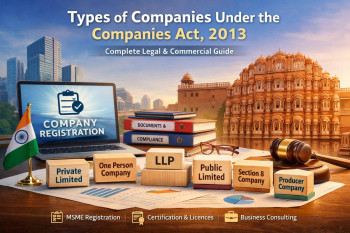
Types of Business Structures in India
Choosing the right structure is the first strategic step in business registration.
1. Private Limited Company
Ideal for startups and scalable businesses
Allows equity funding and ESOPs
Most preferred structure for investors
2. Limited Liability Partnership (LLP)
Suitable for professional firms and SMEs
Lower compliance burden
Flexible profit sharing
3. One Person Company (OPC)
Best for solo entrepreneurs
Limited liability with single ownership
4. Partnership Firm
Simple structure
Limited scalability
5. Branch / Liaison / Subsidiary (Foreign Companies)
Entry route for international businesses
Subject to RBI and FEMA regulations
Selecting the wrong structure is a common mistake that can restrict growth or increase tax burden later.
Legal Authority Governing Company Registration in India
All companies in India are registered and regulated by the Ministry of Corporate Affairs (MCA) through the Registrar of Companies (ROC).
Step-by-Step Company Registration Process in IndiaStep 1: Business Structure & Compliance Planning
Identify business goals and funding plans
Decide ownership and shareholding
Map future licensing and tax requirements
Professional business consulting at this stage avoids costly restructuring later.
Step 2: Digital Signature Certificate (DSC)
Mandatory for directors and shareholders
Used for online filings with MCA
Step 3: Director Identification Number (DIN)
Unique ID for company directors
Applied through incorporation forms
Step 4: Name Reservation
Filed through SPICe+ Part A
Name must be unique and compliant with MCA rules
Tip: Improper name selection often leads to rejection and delays.
Step 5: Drafting Constitutional Documents
Memorandum of Association (MOA)
Articles of Association (AOA)
These documents define:
Business objectives
Governance structure
Rights and duties of stakeholders
Step 6: SPICe+ Incorporation Filing
Integrated form covering:
Company incorporation
PAN & TAN allotment
GST (optional)
EPFO & ESIC registration
Bank account opening
Step 7: Certificate of Incorporation
Issued by ROC with:
Corporate Identification Number (CIN)
PAN & TAN
Your company is now legally incorporated.
Post-Incorporation ROC & AUC Compliance Blueprint
Incorporation is only the beginning. Ongoing compliance ensures uninterrupted operations.
ROC Compliance Requirements
Appointment of first auditor
Opening statutory registers
Filing INC-20A (Commencement of Business)
Annual filings (AOC-4, MGT-7)
AUC (Accounts & Audit Compliance)
Proper bookkeeping
Statutory audit
Income tax return filing
Failure to comply can result in heavy penalties and director disqualification.
MSME Registration: Strategic Advantage for Businesses
MSME registration provides multiple benefits:
Access to government subsidies
Priority sector lending
Protection under MSME Act
Faster dispute resolution
Startups and SMEs in Jaipur, Rajasthan especially benefit from state-level incentives.
Certifications and Licences: Business-Specific Compliance
Depending on your industry, additional certification and licences may be required:
GST Registration
Import Export Code (IEC)
FSSAI License
Shop & Establishment Registration
Professional Tax
Ignoring licensing requirements is a major compliance risk for new businesses.
Practical Examples: India & Global ContextStartup Example
A tech startup incorporated as a Private Limited Company enabled it to:
Raise angel funding
Offer ESOPs
Expand internationally
Foreign Company Example
A Singapore-based company entered India via a wholly owned subsidiary to:
Ensure tax efficiency
Maintain brand control
Comply with FEMA norms
Common Mistakes & Compliance Risks
Choosing the wrong entity structure
Ignoring post-incorporation ROC filings
Delayed MSME registration
Mixing personal and business finances
DIY incorporation without professional review
These mistakes often lead to notices, penalties, and operational disruption.
Why Professional Business Consulting Makes a Difference
A professional business consulting firm offers:
Strategic structure selection
End-to-end compliance management
Industry-specific licensing support
Ongoing advisory for growth and governance
For startups, SMEs, corporates, and foreign companies, expert guidance ensures compliance without distraction from core business activities.
Company Registration Services in Jaipur, Rajasthan
Businesses seeking company registration services in Jaipur, Rajasthan gain:
Local ROC expertise
Faster coordination with authorities
Understanding of Rajasthan-specific incentives
Our consulting team supports clients across Jaipur, Rajasthan, and pan-India with tailored solutions.
Internal Linking Suggestions
Startup Registration Services
MSME Advisory & Compliance
ROC Compliance & Annual Filings
Foreign Company Setup in India
Blog: Private Limited vs LLP – Which Is Better?
Frequently Asked Questions (FAQs)1. How long does company registration in India take?
Typically 7–10 working days if documents are complete.
2. Is MSME registration mandatory?
No, but it is highly recommended for startups and SMEs due to benefits.
3. Can foreign nationals be directors in Indian companies?
Yes, subject to FEMA and RBI guidelines.
4. What is ROC compliance?
ROC compliance includes mandatory filings and disclosures with the Registrar of Companies.
5. Do I need GST registration at incorporation?
GST is mandatory only if turnover or business type requires it.
6. What happens if ROC filings are missed?
Late fees, penalties, and possible director disqualification may apply.
With Jaipur emerging as a startup and SME hub in Rajasthan, compliant company registration is crucial for sustainable growth. Businesses that invest in proper incorporation and compliance gain credibility, scalability, and investor confidence.Planning to start or expand your business in India?
Contact our expert consultants today for end-to-end company registration and compliance services in Jaipur, Rajasthan, and across India.
Build your business on a strong, legally compliant foundation with professional guidance you can trust.