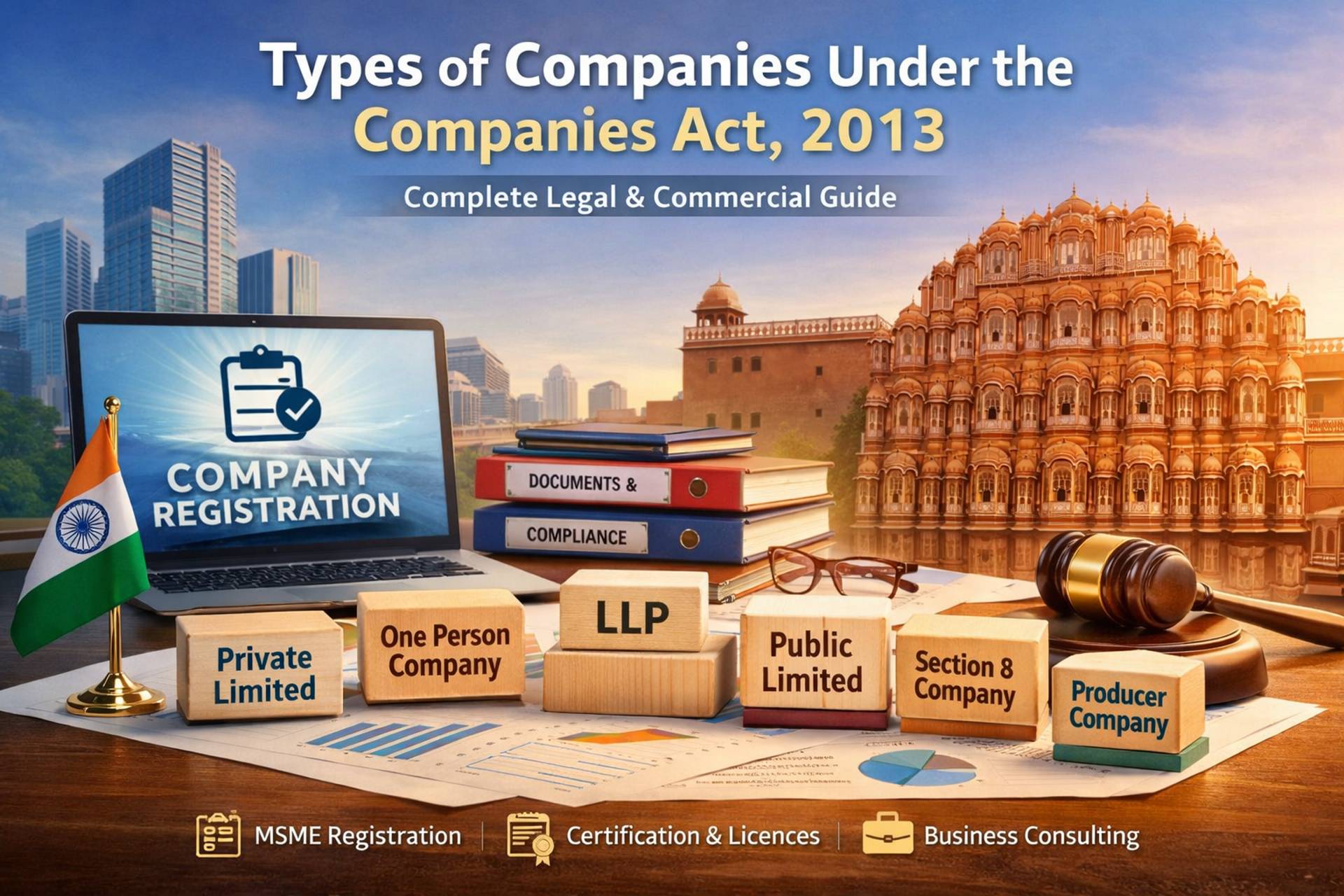
Choosing the right business structure is one of the most important decisions for startups, SMEs, corporates, and foreign companies entering India. The Companies Act, 2013 provides a comprehensive legal framework governing company registration, management, compliance, and growth.
This guide explains all types of companies under the Companies Act, 2013, their legal characteristics, advantages, compliance requirements, and commercial suitability. It is especially useful for entrepreneurs and businesses looking for company registration in Jaipur, Rajasthan, and across India.
Why Understanding Types of Companies Is Crucial for Business Success
The structure of your company directly impacts:
-
Ownership and control
-
Liability of promoters and directors
-
Taxation and funding options
-
Regulatory and compliance burden
-
Scalability and investor confidence
Selecting the wrong structure may lead to higher taxes, compliance risks, or difficulty in raising funds. Professional business consulting services help align your legal structure with long-term commercial goals.
Overview of the Companies Act, 2013
The Companies Act, 2013 replaced the earlier 1956 Act to modernize corporate governance in India. It defines:
-
Types of companies
-
Incorporation procedures
-
Roles of directors and shareholders
-
Compliance, reporting, and penalties
For any business registration in India, this Act is the primary governing law.
Classification of Companies Under the Companies Act, 2013
Companies can be classified based on liability, number of members, control, ownership, and objectives.
1. Private Limited CompanyKey Features
-
Minimum 2 members, maximum 200
-
Limited liability
-
Restriction on share transfer
-
Cannot invite public to subscribe to shares
Best Suited For
-
Startups
-
SMEs
-
Family-owned businesses
-
Foreign subsidiaries
Advantages
-
Separate legal entity
-
Easier fundraising than LLPs
-
High credibility with investors and banks
Practical Example
Most startup registration cases in India prefer Private Limited Companies for angel and VC funding.
2. Public Limited CompanyKey Features
-
Minimum 7 members, no maximum limit
-
Can raise capital from the public
-
Shares freely transferable
Best Suited For
-
Large corporates
-
Businesses planning IPOs
Advantages
-
Access to large-scale funding
-
Higher market credibility
Compliance Risk
Heavy disclosure and regulatory compliance make professional advisory essential.
3. One Person Company (OPC)Key Features
-
Single promoter
-
Limited liability
-
Separate legal identity
Best Suited For
-
Solo entrepreneurs
-
Consultants and professionals
Limitations
-
Restrictions on turnover and conversion
-
Not suitable for large fundraising
4. Limited Liability Partnership (LLP)Key Features
-
Hybrid of partnership and company
-
Limited liability of partners
-
Flexible internal structure
Best Suited For
-
Professional firms
-
Small service-based businesses
Comparison with Company
LLPs have fewer compliances but limited fundraising capability compared to companies.
5. Section 8 Company (Non-Profit Company)Key Features
-
Formed for charitable or social objectives
-
Profits reinvested, not distributed
Best Suited For
-
NGOs
-
Educational and social enterprises
Special Note
Requires additional approvals and ongoing compliance.
6. Producer CompanyKey Features
-
Formed by farmers or producers
-
Combines cooperative and corporate benefits
Best Suited For
-
Agricultural and rural businesses
7. Government CompanyKey Features
-
At least 51% shareholding by government
-
Governed by special provisions
Best Suited For
-
Public sector undertakings
8. Foreign CompanyKey Features
-
Incorporated outside India
-
Has a place of business in India
Best Suited For
-
Multinational companies entering India
Compliance Requirement
Mandatory filings with Indian authorities and RBI regulations.
Step-by-Step Process of Company Registration in IndiaStep 1: Business Structure Selection
Choose the appropriate company type based on funding, liability, and growth plans.
Step 2: Digital Signatures (DSC)
Required for directors and authorized signatories.
Step 3: Director Identification Number (DIN)Step 4: Name Approval
Unique name approval through MCA portal.
Step 5: Incorporation Filing
Submission of MOA, AOA, and statutory documents.
Step 6: PAN, TAN & Bank Account
Automatic issuance post-incorporation.
Professional guidance ensures faster and error-free company registration in Jaipur and across India.
MSME Registration, Certification and Licences
After incorporation, businesses often require:
-
MSME registration for government benefits
-
GST registration
-
Industry-specific certification and licences
-
Shops & Establishment registration
Proper post-registration compliance is as important as incorporation itself.
Common Mistakes & Compliance Risks
-
Choosing the wrong company type
-
Ignoring future funding plans
-
Non-compliance with annual filings
-
Mixing personal and company finances
-
Delayed registrations and licences
Such mistakes can attract penalties and affect business credibility.
Benefits of Professional Business Consulting Services
Engaging a professional consulting firm ensures:
-
Correct legal structure selection
-
End-to-end business registration support
-
Compliance management and advisory
-
Strategic planning for scaling and investment
For startups and corporates, expert advice reduces long-term risks.
Company Registration & Business Consulting Services in Jaipur, Rajasthan
Businesses opting for company registration services in Jaipur, Rajasthan benefit from:
-
Local regulatory understanding
-
Faster coordination with authorities
-
Personalized advisory for Rajasthan-based enterprises
Our consulting services in Jaipur, Rajasthan support startups, SMEs, corporates, and foreign companies across industries.
Internal Linking Suggestions
-
Company Registration Services
-
Startup Registration Advisory
-
MSME Registration Services
-
Certification & Licences Support
-
Blog: LLP vs Private Limited Company
Frequently Asked Questions (FAQs)1. Which is the best company type for startups in India?
Private Limited Company is most preferred due to funding and scalability benefits.
2. Can a foreign company register in India?
Yes, foreign companies can set up subsidiaries or branch offices in India.
3. Is MSME registration mandatory?
It is not mandatory but highly beneficial for incentives and subsidies.
4. How long does company registration take?
Typically 7–10 working days, subject to approvals.
5. Can I convert OPC or LLP into a Private Limited Company?
Yes, conversion is permitted subject to legal conditions.
6. Do I need professional help for company registration?
Professional support ensures compliance, accuracy, and long-term efficiency.
Conclusion: Build on the Right Legal Foundation
Understanding the types of companies under the Companies Act, 2013 is essential for building a compliant and scalable business. The right structure supports growth, investment, and operational efficiency.
For entrepreneurs and organizations seeking reliable company registration and business consulting services in Jaipur, Rajasthan, expert guidance can make all the difference.
Planning to start or restructure your business?
Contact our expert business consulting team today for end-to-end company registration, MSME registration, certification and licences, and strategic advisory services in Jaipur, Rajasthan and across India.